Decivilization
The Call of the WildDecivilization names the transformation by which Buck ceases to be a protected aristocratic dog and becomes a creature adapted to the Northland’s primitive struggle. His change begins in coercion: kidnapping, the club, hunger, labor, and the law of club and fang teach him that civilized assumptions can mean death. Yet the process does not merely destroy him. It uncovers inherited abilities, restores forgotten instincts, and gives him an independent subjecthood that can survive human violence, love beyond duty, and finally answer the call of the wild.
From Civilized Estate to Violent Instruction
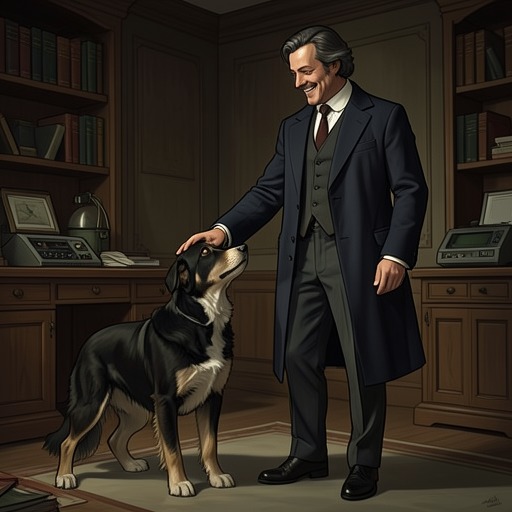
Buck’s starting point is the ordered abundance of Judge Miller’s California estate, where he rules as neither house dog nor kennel dog. He swims in the cement tank, hunts with the Judge’s sons, escorts Mollie and Alice on rambles, guards the Judge’s grandsons, and rests before the library fire. At four years old and one hundred and forty pounds, he possesses the dignity of a well-fed aristocrat, but outdoor activity has kept him muscular rather than merely pampered. His identity is therefore social as well as physical: he belongs to a household whose habits teach command, guardianship, and mutual respect.
That world collapses through Manuel’s treachery. While the Judge is away and the family is occupied, Manuel leads Buck through the orchard to College Park and delivers him to a stranger for money. The rope tightened beneath Buck’s collar is the first sign that he has become transferable property rather than a member of a protected domestic order. His resistance is answered by the man in the red sweater, whose club repeatedly smashes down Buck’s charges. Buck is beaten until blood runs from his nose, mouth, and ears, yet the result is not submission in the sense of inner destruction. He learns that no dog can defeat a man with a club and that the weapon represents a power more fundamental than the moral claims of his former life. The lesson is his introduction to primitive law.
The decisive feature of this initiation is Buck’s continued agency. He is beaten, but not broken; after receiving water and raw meat from the man’s hand, he retains his will while abandoning the belief that courage alone can overcome superior force. The club does not simply punish him. It reorganizes his perception of reality, teaching him to combine defiance with caution and to replace open reliance on civilized protection with alertness, calculation, and survival.
Hunger, Work, and the Loss of Moral Habit
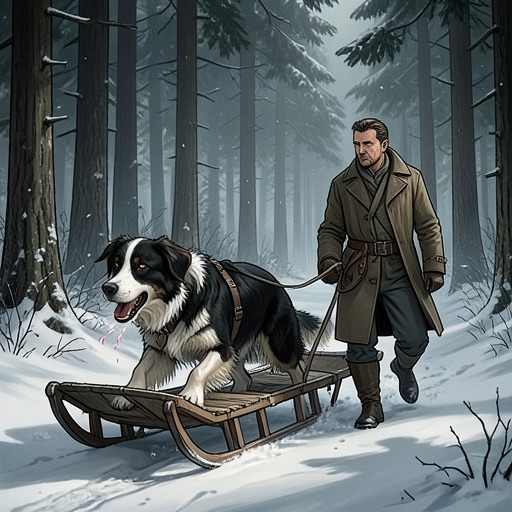
The Northland completes what the club began. Buck works day after day in the traces, breaking camp in darkness, traveling through the gray dawn, and sleeping in the snow after eating his ration of dried salmon. His pound and a half of fish never satisfies him, while faster companions consume what he leaves. Hunger forces him to abandon the fastidious eating habits of Judge Miller’s estate and to defend or secretly obtain food before it disappears.
His first theft makes the transformation visible. After watching Pike steal bacon, Buck secretly takes an entire piece himself. Dub, an awkward dog who is often caught, is punished for the act. Buck’s success demonstrates not only cleverness but a new relation to property and blame: he no longer treats honesty as an unquestionable rule, and he learns that concealment is safer than open defiance. The theft is not presented as pleasure or moral choice. Hunger makes it easier to steal than to remain bound by the habits of the Southland.
Under the law of club and fang, private property and personal feeling become dangerous luxuries. In the Southland, Buck might have risked himself to defend Judge Miller’s riding whip as a matter of moral loyalty; in the Northland, refusing such a defense can preserve his life. This is the central paradox of decivilization: Buck’s moral nature goes to pieces, but that apparent regression is also an adaptive achievement. He does not reason through a doctrine. His body and conduct adjust before conscious thought can name the change.
The adjustment becomes physiological as well as ethical. Buck’s muscles harden, ordinary pain loses its power, and his body extracts nourishment from food regardless of how loathsome or indigestible it is. His sight, scent, and hearing sharpen; he bites ice from between his toes, breaks ice-covered water holes with his forelegs, and can scent the coming wind a night in advance, digging his nest where later weather will leave him sheltered. Decivilization is thus a remaking of perception and metabolism: the former estate dog becomes an organism fitted to cold, deprivation, movement, and danger.
Heredity and the Return of the Primordial Animal
The deepest layer of Buck’s transformation is described as the revival of instincts long dead through domesticated generations. He learns the wolf snap, the slash, and the quick methods of fighting without formal discovery, as though ancestral knowledge had been waiting within him. The wild is not simply an external environment that imposes new behavior; it is a summons that activates capacities inherited from dogs who once ranged in packs through primeval forests and killed living meat in pursuit.
This ancestral return is dramatized in Buck’s solitary howling. On cold, still nights he points his nose toward a star and gives a long wolf-like cry. The sound belongs simultaneously to the present animal and to dead ancestors whose grief and knowledge of cold, darkness, and silence continue through him. His voice makes heredity audible. The past is not a historical explanation standing outside Buck; it becomes a force moving through his body, shaping his senses, moods, and actions.
The narrative makes Buck’s return to instinct inseparable from the human event that displaced him. He comes into his own because men find yellow metal in the North and because Manuel’s wages cannot support his family. The Gold Rush therefore appears as the human mechanism that accidentally releases an older animal life. Human greed and economic hardship initiate Buck’s dispossession, but the consequence exceeds human intention: the stolen dog becomes a participant in a nonhuman history older than the society that claimed him.
The camp’s violence repeatedly confirms the new order. Buck watches Curly approach a husky and suffer a sudden attack that tears her face open; when she falls, dozens of dogs close over her while men struggle to scatter them. The lesson is absolute: there is no fair play, and once a combatant goes down, the fight is over. Later, starving huskies invade a camp in a frenzy over food, fighting through blows from clubs until every crumb of bread and bacon is gone. These scenes make the Northland a social world, but not a civilized one. Its rules are real, collective, and intelligible, yet they are organized by appetite, dominance, and bodily survival rather than by pity or legal protection.
Buck also experiences the positive exhilaration of this recovered life. During the chase of a snowshoe hare, he leads a pack of sixty dogs and pursues living meat through moonlight, driven by the intimate bloodlust of killing with his own teeth. The chase brings him into an ecstasy in which awareness of the self disappears into movement. Decivilization here is not only deprivation or brutality; it is an intensified sense of being alive, expressed through every muscle and through the ancient rhythms of pursuit.
Love as Resistance and Complication
Decivilization does not eliminate Buck’s capacity for attachment. When John Thornton rescues him, Buck enters a new existence in which love, rather than duty or social position, becomes the organizing force of a relationship. Skeet cleanses his wounds each morning, Nig offers a gentler companionship, and both dogs share Thornton’s kindness rather than showing jealousy. Their play carries Buck through convalescence, but Thornton is the decisive presence: he has saved Buck’s life and cares for his dogs as though they were his children.
Buck’s devotion to John Thornton differs sharply from his former relations with Judge Miller’s household. With the Judge’s sons he had shared a working partnership; with the grandsons he had acted as a dignified guardian; with the Judge himself he had enjoyed a stately friendship. Thornton awakens something more feverish and absolute. His rough embraces, affectionate oaths, and long conversations become sources of ecstasy, while Buck answers with a love gesture that resembles injury by closing his teeth around Thornton’s hand hard enough to leave their impress. The man understands the bite as a caress, and the animal’s apparent violence becomes a language of mutual recognition.
Buck’s love remains watchful and often physically distant. He may lie for hours at Thornton’s feet, studying every change in the man’s face, or watch from the side and rear. Their silent gazes become a form of communion. Buck also fears that Thornton will disappear as earlier masters did, so he follows him everywhere and sometimes wakes from dreams to listen at the tent flap for the sound of his breathing. This anxiety shows that the Northland has not made him incapable of dependence; instead, its succession of temporary masters has made attachment more intense and more vulnerable.
At the same time, Thornton does not reverse Buck’s decivilization. Buck will not steal from Thornton, because love creates a personal prohibition, but he steals from other men without hesitation and uses his cunning to avoid detection. He fights strange dogs mercilessly, having learned that a struggle must end in mastery or death. Thus love and wildness coexist without resolving one another. Thornton provides the one human bond strong enough to hold Buck near the fire, but the bond does not restore the soft Southland dog.
Completion in the Wild
The call of the forest continually tests the limits of Thornton’s hold. Buck repeatedly leaves the fire and beaten earth to move through green shade and soft, unbroken ground, then returns because love draws him back. The remaining claims of mankind mean little to him; even Hans and Pete are tolerated chiefly because they are close to Thornton. Buck belongs at the boundary between human companionship and animal freedom, not securely within either sphere.
His final release comes only after John Thornton’s death. With the last human tie broken, Buck is ready to obey the call without reservation. When the wolf pack enters the valley, he meets it not as prey but as a formidable autonomous creature. He kills the first wolf that leaps at him, wounds others, and holds the pack at bay for half an hour from a position protected by a gravel bank. The encounter proves that decivilization has produced mastery rather than mere ferocity: Buck survives through agility, tactical positioning, and the controlled violence accumulated across his earlier ordeals.
Recognition follows combat. Buck touches noses with the wild brother he once pursued and with an old, battle-scarred wolf. When the old wolf begins the long howl, Buck joins it; the pack then crowds around him and departs with him running beside his wild brother. The scene is a social reintegration, but into a nonhuman community whose membership is earned through strength, endurance, and shared recognition.
The later Yeehat reports complete the transformation into the Ghost Dog. Wolves with brown markings and a white rift down the chest are seen, and the pack’s leader is said to steal from camps, rob traps, slay dogs, and defy hunters. Some hunters fail to return, while others are found with slashed throats and enormous wolf prints around them. The valley becomes a place the Yeehats avoid, and the story of the Evil Spirit gives Buck’s wild existence a legendary afterlife. Decivilization ends not in a return to society but in a new identity beyond human ownership: Buck becomes the feared, cunning leader of a wolf pack, carrying the memory of civilization without remaining governed by it.